
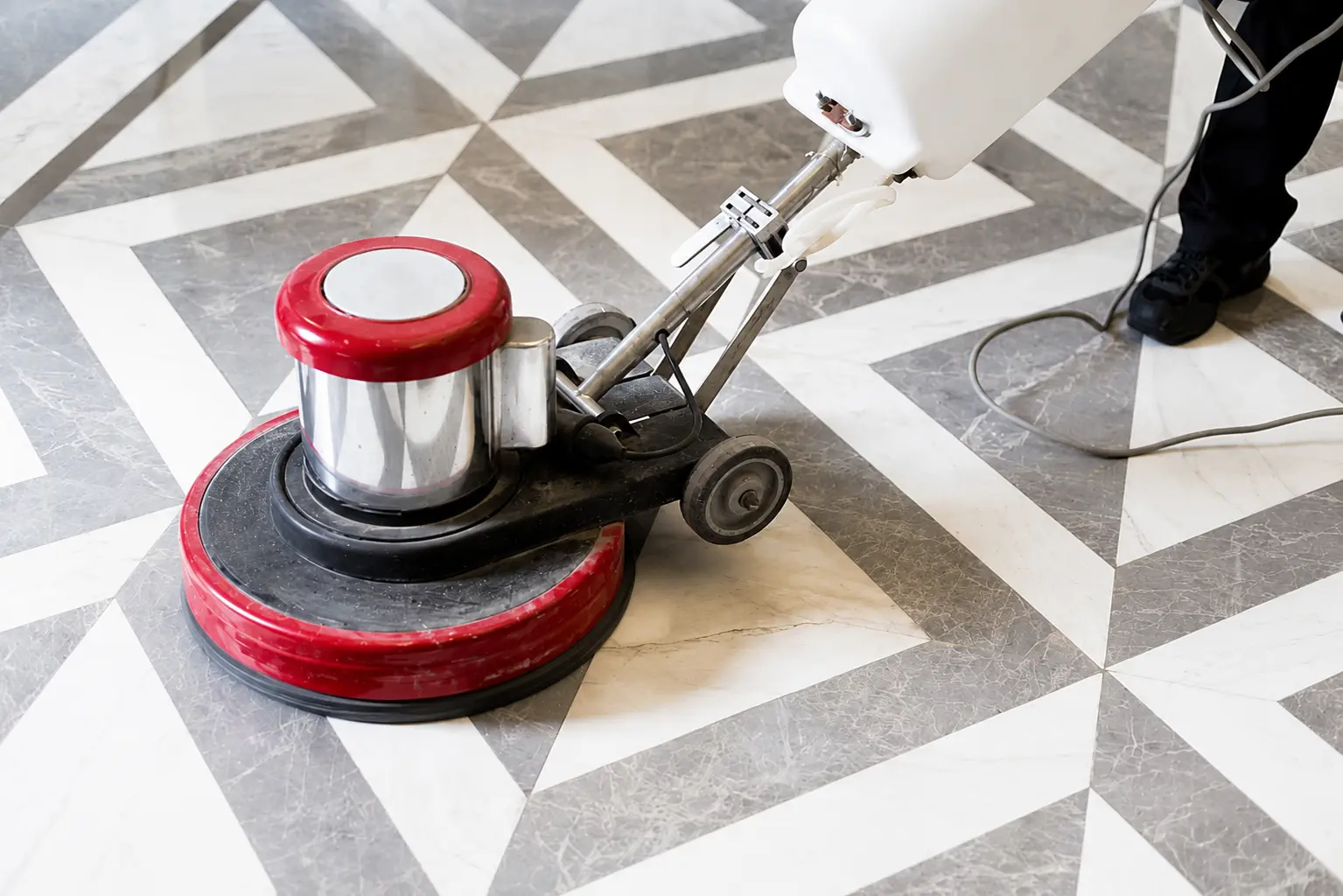
If you’ve been researching how to bring a tired stone or terrazzo floor back to life, you’ve probably seen the words “grinding” and “polishing” used as if they mean the same thing. They don’t. Knowing the difference can be the difference between spending a little and spending a lot — so here’s a plain explanation of each, and how to work out which one your floor needs.
A dull, scratched or lifeless floor doesn’t automatically mean it’s beyond saving. In most cases, you can restore the surface you already have to something close to its original condition. The question is how much work it needs to get there — and that’s where grinding and polishing come in.
They sit on the same spectrum, but they solve different problems.
What polishing does
Polishing is the lighter of the two. It restores shine to a floor that is still in good structural condition but has simply lost its lustre over time.
If your stone or terrazzo isn’t badly damaged — no deep scratches, no worn-through sealer, no serious etching — polishing can bring the shine back relatively quickly, without stripping the surface right down. Think of it as the finishing touch on a floor that’s fundamentally sound.
What grinding does
Grinding is the heavier intervention, and it’s needed when the damage runs deeper.
Rather than just working on the surface shine, grinding strips away old sealers and worn material to take the floor back toward its original surface. That gives a clean base to rebuild the finish from scratch. Grinding is what you turn to when a floor is scratched, etched, unevenly worn, or coated in years of old, failing sealer that polishing alone can’t fix.
In almost every case, a badly worn floor is ground first and then polished. The grinding does the repair; the polishing brings back the shine.
The easiest way to picture it
The clearest comparison is refinishing a wooden floor.
Sometimes a timber floor just needs a fresh coat of varnish to look good again. Other times the old finish is too far gone, and you have to strip it right back to bare wood before you can build the finish up.
Stone and terrazzo work exactly the same way. Polishing is the fresh coat of varnish. Grinding is stripping back to bare timber. Same floor, very different amount of work — and the only way to know which yours needs is to look at the actual condition of the surface.
How the professional process actually works
When a floor does need grinding, it isn’t a single pass with one machine. It’s a progressive sequence, using diamond abrasive pads that work much like grades of sandpaper — starting coarse to remove damage, then moving through finer and finer grades to refine the surface.
Depending on how much damage there is, that sequence can run through several stages: 50, 100, 200, 400, 800, 1,500 and then 3,000 grit. Each stage removes the scratches left by the one before it. Once the surface is properly prepared, diamond-tip buffing pads bring back the shine.
It’s methodical and time-consuming — and that’s exactly the point. All of that effort exists to restore the floor you already have, rather than face the far greater cost and mess of tearing it out and starting again.
Which floors can be ground and which can’t
Grinding suits natural stone and terrazzo surfaces that have enough material to be resurfaced: marble, granite, travertine, slate, sandstone, terrazzo and concrete-based finishes all fall into this group.
Ceramic and porcelain are the exception. Their hard glazed surface can’t be ground back — so if your floor is ceramic or porcelain, grinding isn’t the answer. That doesn’t mean a dull or stained ceramic floor is a lost cause; it usually just means the right treatment is professional cleaning and sealing instead. our cleaning and sealing service covers that.
The part most people don’t hear: you can’t grind forever
Here’s something worth knowing before you commit to anything, because not everyone will tell you.
A floor can only be ground down a limited number of times over its lifetime. Every grind removes a thin layer of material, so there’s a natural ceiling on how often it can be done — much like a solid timber floor, which can typically only be sanded a couple of times before there’s not enough material left to work with.
Terrazzo shows this especially well. Because it’s made of stone chips set into a base, repeated grinding can eventually expose those chips above the surface glaze. In most cases the floor still looks excellent — we’ve seen heavily used terrazzo floors that have been ground several times and are still beautiful — but it’s a real limit, and an honest specialist will point it out before starting the work rather than after.
This is exactly why a proper assessment matters more than a quick quote. Grinding a floor that only needed a polish wastes material you can’t get back.
So which does your floor need?
As a rough guide:
- If your floor has lost its shine but isn’t damaged, you’re likely looking at polishing.
- If it’s scratched, etched, unevenly worn, or covered in old failing sealer, it probably needs grinding first, then polishing.
- If it’s ceramic or porcelain, grinding is off the table — cleaning and sealing is the route.
But “rough guide” is the operative phrase. The honest answer is that the right treatment depends on the specific surface, its material, and how much wear it’s carrying — which is something you can only judge properly by inspecting the floor itself. That’s why we always start with an assessment before recommending anything.
The bigger picture: restore before you replace
Whichever your floor needs, the underlying point is the same one we come back to again and again: a worn floor is very rarely beyond saving, and restoring it almost always costs a fraction of ripping it out and replacing it. We wrote more about that trade-off in “Restore, Don’t Replace: Why Your Tiles Probably Aren’t Beyond Saving”, if you’d like the full argument.
Not sure which your floor needs?
That’s the honest place most people start from — and it’s exactly what an inspection is for. If you’re in Durban or the wider KwaZulu-Natal area, get in touch and we’ll assess your surface, explain what’s realistic, and recommend the right approach. You can read more about how we work on our