
There is a particular moment most homeowners reach with a tiled floor.
You have scrubbed the grout. You have tried three different products from the hardware store. The floor still looks tired, the grout lines are still grey, and the stone in the entrance hall has lost the shine it had when you moved in. So you start pricing new tiles, and you brace yourself for the disruption.
We would like to suggest a different starting point.
In our experience, most floors that people are ready to replace do not need replacing. They need restoring — and the difference between those two words is usually measured in tens of thousands of rands and several weeks of your life.
The assumption most people make
The assumption is that a floor which no longer looks good has worn out.
Occasionally that is true. Far more often, what has actually happened is that layers of material have built up on top of the surface, or a protective sealer has broken down, and the tile or stone underneath is in perfectly sound condition.
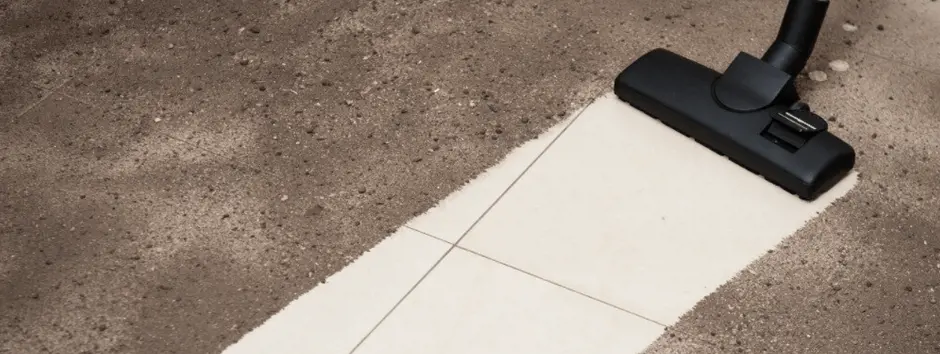
You are not looking at a worn floor. You are looking at a covered one.
This is easy to miss, because the deterioration happens slowly. A floor does not look bad on a Tuesday. It looks slightly less good every month for six years, and then one day you notice.
What restoration actually removes
When we assess a floor, we are working out which of these four things is causing the appearance you dislike. Usually it is more than one.
Built-up soil and cleaning residue
Household cleaners are designed to be convenient, not to rinse cleanly. Many of them leave a thin film behind. That film attracts and holds dirt, and each subsequent clean adds another layer.
Over years, this builds into a dull, slightly tacky coating that ordinary mopping cannot lift, because ordinary mopping is what created it. Professional stripping removes the whole accumulation and takes you back to the actual surface.
This alone is often responsible for the majority of the improvement people see.
Sealer that has broken down
Sealers do not last forever, and they are not supposed to. They are a consumable layer that takes the damage so the surface underneath does not have to.
When a sealer reaches the end of its life it does not disappear neatly. It goes patchy, it yellows, it traps dirt beneath itself, and it stops repelling moisture. A floor with failed sealer often looks worse than a floor with no sealer at all.
Stripping the old sealer and applying a fresh, appropriate one is a routine part of restoration — and on the KZN coast, where humidity and salt air shorten sealer life, it is needed more often than most people expect.
Surface scratching and loss of finish
Natural stone — travertine, marble, granite, terrazzo — has a polished finish that is mechanical, not chemical. It is created by grinding the surface progressively finer until it reflects light.
Foot traffic, grit and abrasive cleaners scratch that finish at a microscopic level. Enough tiny scratches and the surface scatters light instead of reflecting it, which we perceive as dullness.
This is the part people assume is permanent. It very rarely is. Because the finish is mechanical, it can be re-created — the surface is ground and polished back through the same sequence of grades that produced it originally. The stone itself is barely affected; we are working within a fraction of a millimetre.
Grout that has discoloured
Grout is porous by nature. It absorbs everything that lands on it, and in wet areas it holds moisture long enough for organic growth to take hold.
Discoloured grout can usually be cleaned and re-sealed. Where it has been damaged, cracked or lost, it can be raked out and replaced without touching the tiles around it. Grout is also the one element that can be recoloured, which means a floor with mismatched or patchy grout lines can be brought back to a consistent finish.
Where restoration has limits
We would rather tell you this before you book than after we arrive.
Restoration is not appropriate in every case, and there are conditions we cannot correct:
Structural cracking. If tiles are cracking in a line across the floor, or lifting and drumming underfoot, the problem is beneath the tile — movement in the slab, a failed screed, or missing expansion joints. Restoring the surface would be treating a symptom. That work needs a different trade, and we will tell you so.
Deep chips and impact damage. Small chips can often be filled convincingly. A tile that has taken a heavy impact and shattered needs replacing, and if you have no spare tiles from the original installation, matching it is difficult.
Glaze worn through. On glazed ceramic and porcelain, the decorative surface is a thin layer. Once foot traffic has worn through it — usually in doorways and along traffic paths — there is nothing left underneath to restore. This is uncommon in domestic settings but does occur in older commercial floors.
Some deep staining in porous stone. Oil, wine and rust that have been left to penetrate untreated stone can migrate deep into the material. Poultice treatments lift a great many of these. Not all of them. We will always test an inconspicuous area before we quote on stain removal, so that nobody is working on assumptions.
Badly laid tile. Uneven lippage, inconsistent grout lines and poor falls in a shower are installation faults. Grinding can reduce lippage in some cases, but a floor that was laid badly will always read as a floor that was laid badly.
What it costs compared with replacing
The tile price is the smallest part of a replacement.
The full cost of lifting and relaying a floor includes demolition and removal of the existing tile, disposal of the rubble, preparation or re-screeding of the substrate, new tile, adhesive, grout, labour, and usually skirtings. Doors sometimes need trimming to clear a new floor height. Furniture has to go somewhere. And for anywhere from several days to a few weeks, you are living around a building site — or, if it is a business, losing the use of the space entirely.
Restoration involves none of the above. There is no demolition, no rubble, no substrate work and no waiting for adhesive to cure. Most domestic floors are completed within a day or two, and the space is usable again shortly afterwards.
Across the projects we quote on, restoration typically costs a fraction of full replacement — and it is the second set of costs, the ones that do not appear on the tile shop’s quote, that make the gap as wide as it is.
How to tell which camp your floor is in
Two things you can check yourself before you call anyone.
The water test. Place a few drops of water on the surface in a traffic area and leave it for five minutes. If it beads and sits, your sealer is still working and the problem is on top of it. If it soaks in and darkens the surface, the sealer has gone and the material is absorbing everything else too.
The hidden-corner test. Find a spot the traffic never reaches — under a cupboard, behind a door, in the corner of a room. Compare it to the open floor. If the hidden section still looks the way you remember the floor looking, then the material is sound. What you are unhappy with is the accumulated surface condition, and that is exactly what restoration addresses.
If the hidden corner looks as tired as the rest, or if you are seeing cracks and movement, call us anyway — but expect an honest answer about whether restoration is the right route.
The next step
We inspect before we quote, always. That means identifying the material, assessing the grout, testing the sealer and, where necessary, trialling a small area so that everyone knows what the outcome will look like before any commitment is made.
If the answer is that your floor genuinely needs replacing, we will tell you that. We would rather lose a job than take on work that will not produce a result you are pleased with.
Book an Inspection — or browse our restoration services to see the surfaces we work with across Durban and KwaZulu-Natal.