
Sealing is the step that keeps a clean floor clean. But not all sealers work the same way, and the biggest decision is a simple one: should the sealer soak into the surface, or form a coating on top of it? Get that right and your floor stays protected and looks the way you want. Get it wrong and you can trap moisture, create a slip risk, or find yourself stripping the floor far sooner than you should.
Here is a plain guide to the two kinds of sealer, where each one belongs, and how to work out which your floor actually needs.
First, why seal at all?
Most hard floors are more porous than they look. Natural stone, grout, terracotta and unglazed surfaces are full of tiny pores that quietly drink in water, oil, dirt and spills. Once those contaminants soak in, they are difficult or impossible to remove, and the surface starts to stain, darken and break down.
Sealing closes that door. It stops the surface absorbing what lands on it, so spills sit on top long enough to be wiped away, grout resists the grime and mould that turn it black, and the floor stays cleaner between washes. In short, sealing protects the floor you have already paid for, and it is a large part of why a well-maintained floor can outlast the building around it.
The catch is that the word sealer covers two very different products.
The two families, in plain terms
Sealers that soak in (penetrating, or impregnating)
A penetrating sealer sinks into the pores of the tile, stone or grout and protects it from the inside. Rather than laying a film over the surface, it lines the pores so water and oil are repelled from within. The technical name is an impregnating sealer, and the important part is what it does not do: it does not sit on top.
Because the protection is inside the material, a penetrating sealer leaves the surface looking and feeling completely natural. There is no added shine and no change to how grippy the floor is underfoot. It cannot peel or flake off, because there is no film to peel. It can be topped up in one worn patch without stripping the whole floor, and it generally lasts longer than a coating. The trade-off is simply that it will not give you a glossy, wet-look finish, because it is designed to be invisible.
This is the sealer of choice for most natural stone, for grout, and for anywhere the floor should look untouched.
Sealers that coat the surface (topical, or coating)
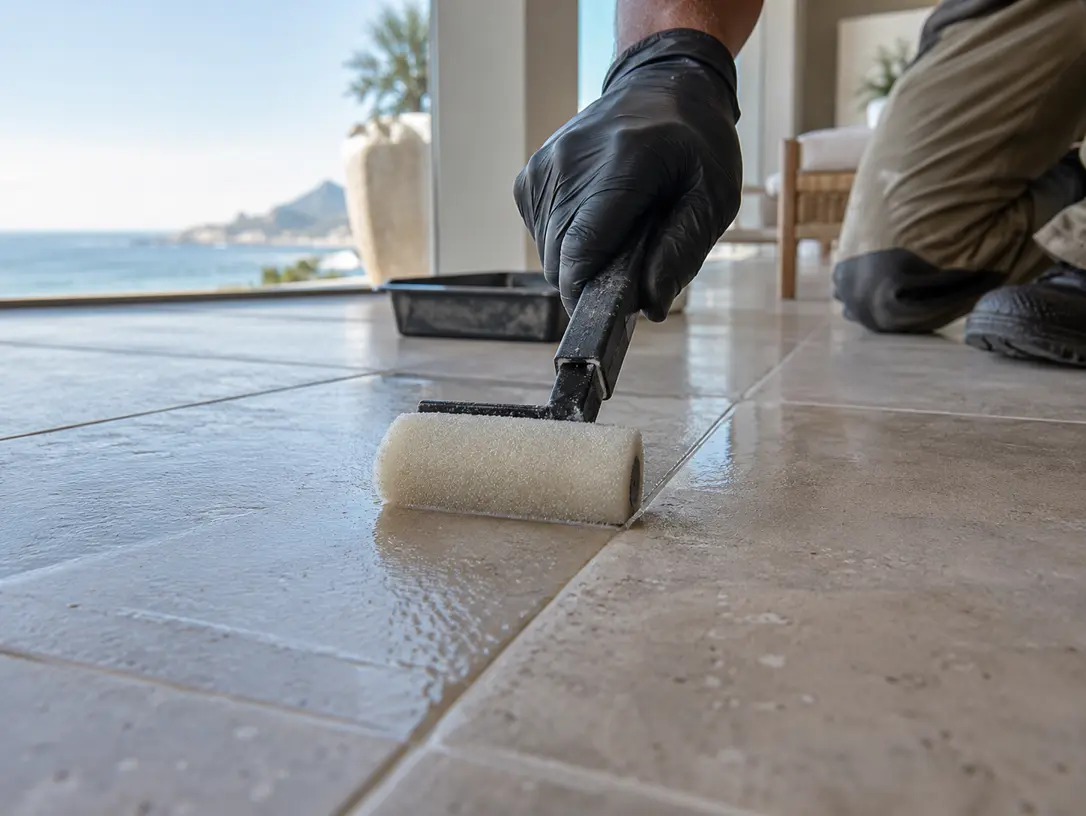
A topical sealer does the opposite. It stays on top and forms a protective film, a bit like a fine coat of varnish, usually built up over several coats. That film is a physical barrier between the floor and everything that lands on it, and it can add sheen, gloss or a richer colour if that is the look you are after.
The barrier has real strengths. It wipes clean easily, it can make a tired surface look richer, and it gives you control over the finish, from satin to high gloss. But a coating also behaves differently in use. It wears unevenly, thinning first along the paths people actually walk, so over time you see traffic lanes. When it wears out you cannot simply add more, because a fresh coat will not bond evenly over the old one. The floor has to be stripped back and recoated. A film can also change how slippery the surface is, especially when wet, and because most coatings are not breathable, they can trap moisture underneath if the floor is damp, which leads to clouding or lifting.
Used in the right place, a coating is excellent. Used in the wrong place, it creates the very problems people call us to fix.
A closer look at the coating types
If you do want a coating, it is worth knowing that topical sealer covers a few different chemistries. The three you will hear about most are acrylic, polyurethane and epoxy.
Acrylic is the cheapest and easiest to apply, and it dries quickly. It is also the thinnest and the shortest-lived, wearing through fastest in busy areas and needing recoating most often. It has long been used on terracotta and clay tiles for that reason.
Polyurethane is a step up. It forms a dense, hard-wearing film with strong resistance to scuffs, abrasion and household chemicals, and it is more flexible than epoxy, so it copes better with a floor that expands and contracts. The better versions hold their colour without yellowing, which makes polyurethane a sensible choice for interior floors and busy spaces. This is the coating we most often reach for when a coating is the right answer.
Epoxy is the hardest of the three. It is usually a two-part product mixed on site, and once cured it forms a very tough, high-gloss, chemical-resistant surface. That toughness makes epoxy popular for grout lines and heavy-duty commercial interiors. It has two well-known limits, though. It is not stable in sunlight and tends to yellow outdoors, so it is really an indoor product, and because it is completely non-porous it can trap moisture beneath it and lift if the floor is not bone dry when it goes on.
None of these is simply the best. Each suits a different surface, setting and level of wear, which is the whole point of choosing carefully.
Which sealer does your floor actually need?
The right sealer depends far more on the surface than on brand or price. As a general guide:
Natural stone (marble, travertine, slate, slasto, sandstone, limestone). Porous, and almost always worth sealing. A penetrating sealer is usually the right call because it protects without changing the natural look. If you want to deepen the colour, a colour-enhancing penetrating sealer can do that without laying down a glossy film.
Glazed ceramic and porcelain. The tile itself is dense and non-porous, so the tile usually does not need sealing at all. The grout between the tiles is another story. It is porous, and it is where the dirt, staining and mould take hold, so sealing the grout is what keeps a ceramic or porcelain floor looking clean.
Grout, everywhere. Grout is the weak point on almost every tiled floor. Sealing it, usually with a penetrating sealer, is the single most effective thing you can do to keep a floor looking new for longer.
Terracotta, saltillo and clay. Very porous and traditionally finished with a coating, though a penetrating or enhancing sealer is often a lower-maintenance choice today.
Outdoors, pool surrounds and wet areas. This is where the choice matters most, and it is especially relevant on the KwaZulu-Natal coast, where humidity, salt air and outdoor living are part of daily life. A coating outdoors can turn slippery when wet and can trap moisture in a floor that never fully dries, which is exactly the wrong result around a pool. A penetrating sealer keeps the surface breathable and does not change how grippy it is. For showers, bathrooms and pool surrounds where safety matters, an anti-slip treatment can be added to improve grip without changing how the floor looks.
If your natural stone or terrazzo is not just dirty but genuinely worn or scratched, sealing alone will not fix it. It may need grinding and polishing to restore the surface first, and then sealing to protect it. We will always tell you honestly which your floor needs.
How long does a sealer last?
There is no single answer, because it depends on the surface, how much traffic it takes, how wet the area gets, and how the floor is cleaned. As a rough guide, natural stone is often resealed every one to two years, and grout somewhere in the one to three year range, with high-traffic and wet areas needing attention sooner. Coatings tend to show wear in the traffic lanes first and eventually need a full strip and recoat rather than a top-up.
You do not have to guess. There is a simple test: drip a little water onto the surface and watch. If it beads up and sits there, the seal is still doing its job. If it soaks in and the surface darkens within about a minute, it is time to reseal.
Two things extend the life of any sealer. The first is cleaning with a pH-neutral cleaner rather than harsh or acidic products, which strip sealer faster than anything else. The second is resealing on time rather than late. A penetrating sealer can be topped up again and again over the life of a floor, so protecting a floor is an ongoing habit, not a one-off job.
So, absorbed or coated?
For most homes, and for most natural stone and grout, a penetrating sealer that soaks in is the better long-term choice. It protects invisibly, it does not peel or turn slippery, and it can be maintained without stripping the floor. A coating earns its place where you specifically want a sheen, a richer colour or a hard wipe-clean barrier, and where the surface and setting suit it.
The honest answer is that the right sealer depends on your floor, where it is, how you use it and the look you want. That is a judgement call, and it is one worth getting right, because the wrong sealer is expensive to undo.
At Tile Care SA we assess the surface first, then choose between a penetrating sealer, a coating such as polyurethane, or an anti-slip treatment based on what your floor actually needs, and we explain why. You can read more about how we clean and protect floors on our cleaning and sealing service page.
Not sure which sealer is right for your floor?
If you are in Durban or anywhere across KwaZulu-Natal, get in touch and we will assess your surface and recommend the right approach, honestly.